Syed Ahmed Ali ShahSoftware developer · Pakistan
8 projects · 3 live

Selected work.

Production web apps, decentralized smart contracts, and data-driven tools — built to actually run, not just demo.


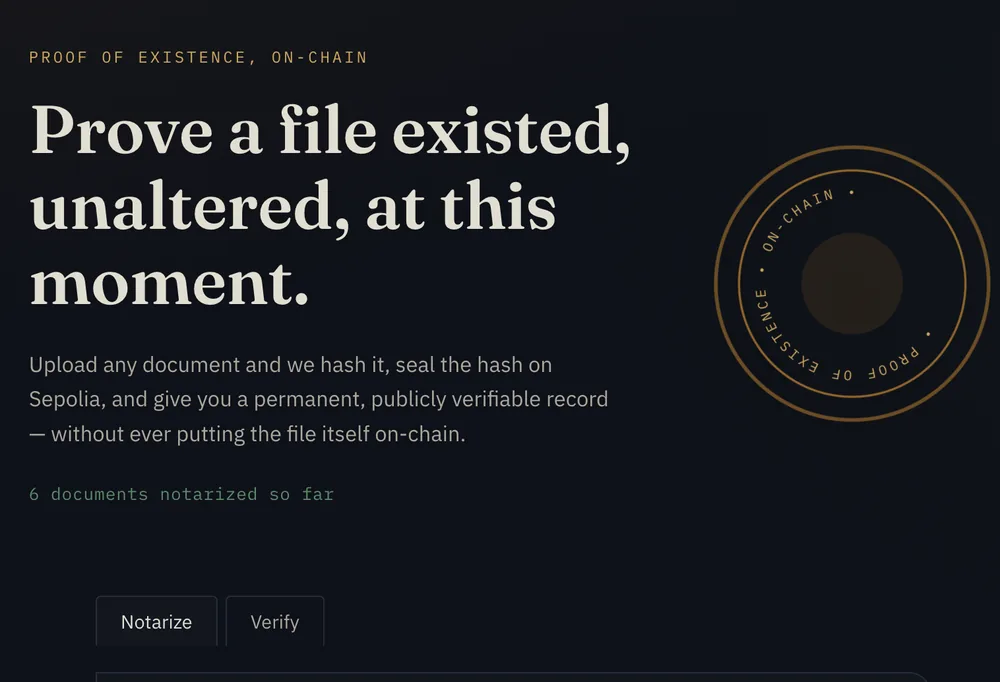
Screenshot of the Decentralized Document Notary interface
01Live

Decentralized Document Notary

The problem: proving a document existed in a specific state at a specific time, without trusting a single company's database to not quietly change it later. Traditional notarization solves this with a person and a stamp; this project solves it by hashing the document with SHA-256 and writing that hash to a smart contract on Sepolia — so the proof of existence lives on a public, append-only ledger instead of in someone's private table.

The interesting engineering problem wasn't the smart contract itself (that part is genuinely simple) — it was everything around it. Files themselves are too large and too sensitive to put on-chain, so the actual documents live in Cloudflare R2, with Supabase handling user accounts, metadata, and the mapping between a file and its on-chain hash. The contract only ever sees a hash, never the document. Deployed across three different platforms doing three different jobs — Vercel for the frontend, Render for a small backend service, Sepolia for the actual notarization — which turned out to be a good, if accidental, lesson in keeping deploy responsibilities cleanly separated.

Contract
Solidity
Frontend
React
Backend
Node.js · Supabase · Cloudflare R2
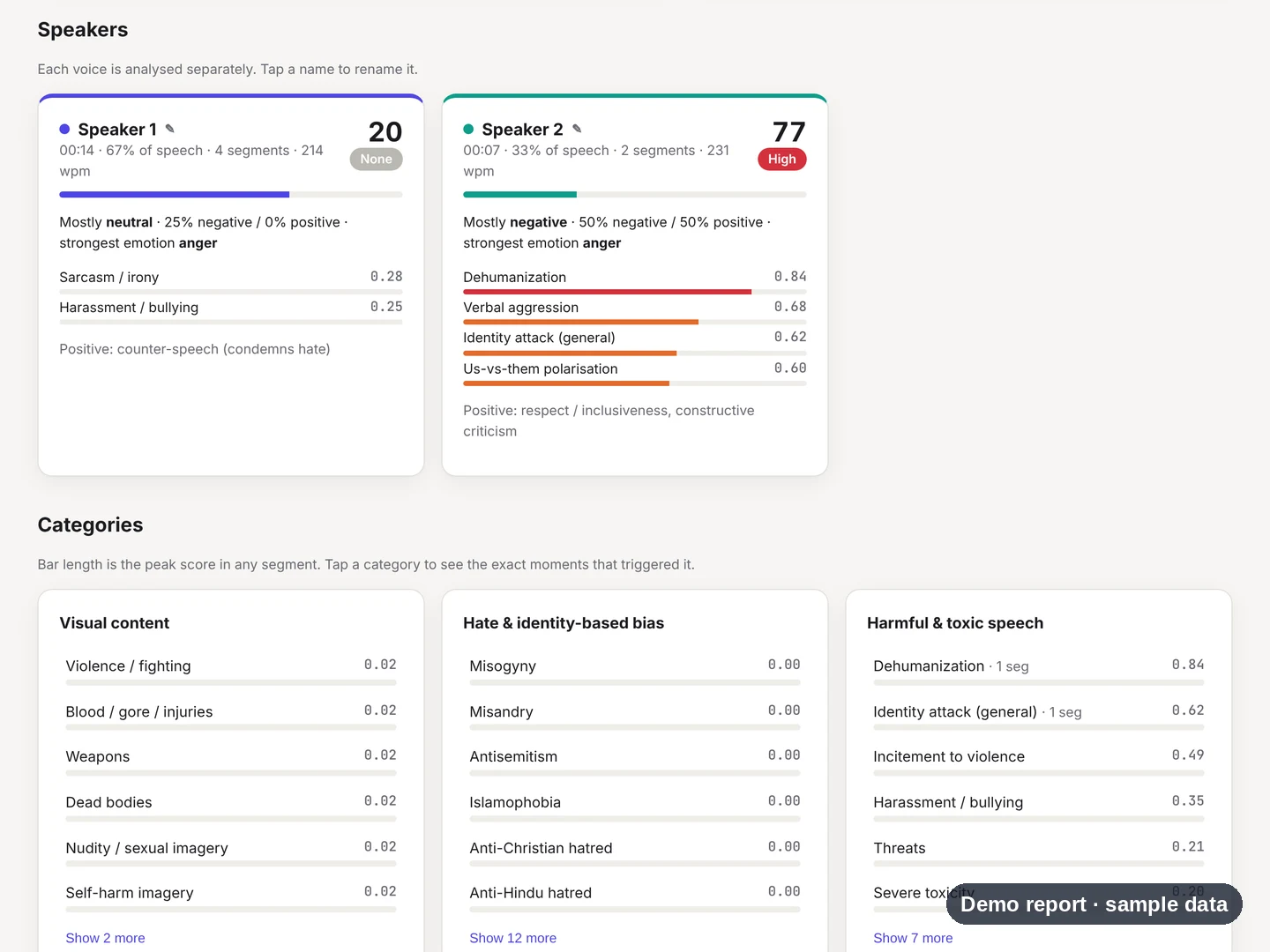
Screenshot of the Spectra interface
02

Spectra

The problem: reviewing hours of spoken video for hate speech, threats or manipulation by hand is slow, and most tools only read English text. Spectra transcribes and translates the speech, separates the speakers, and reads the words, the voice and the face together, so a reviewer gets one report where every flag points to the exact moment that triggered it.

Built for Urdu, Punjabi, Roman Urdu, Hindi and English. Whisper transcribes and translates; speakers are separated with ECAPA voice embeddings and clustering; ten models score sentiment, 28 emotions, toxicity, hate speech, sarcasm and 50+ zero-shot categories, from misogyny, antisemitism and Islamophobia to propaganda and counter-speech. Voice prosody, facial expression and a per-second visual check for disturbing imagery feed the same risk score. Customers get a read-only report through expiring, watermarked share links served by a Cloudflare Worker from private R2 storage.

Models
Whisper · DeBERTa · CLIP · wav2vec2
Backend
Python · FastAPI · Job queue
Delivery
JS dashboard · Cloudflare Worker · R2
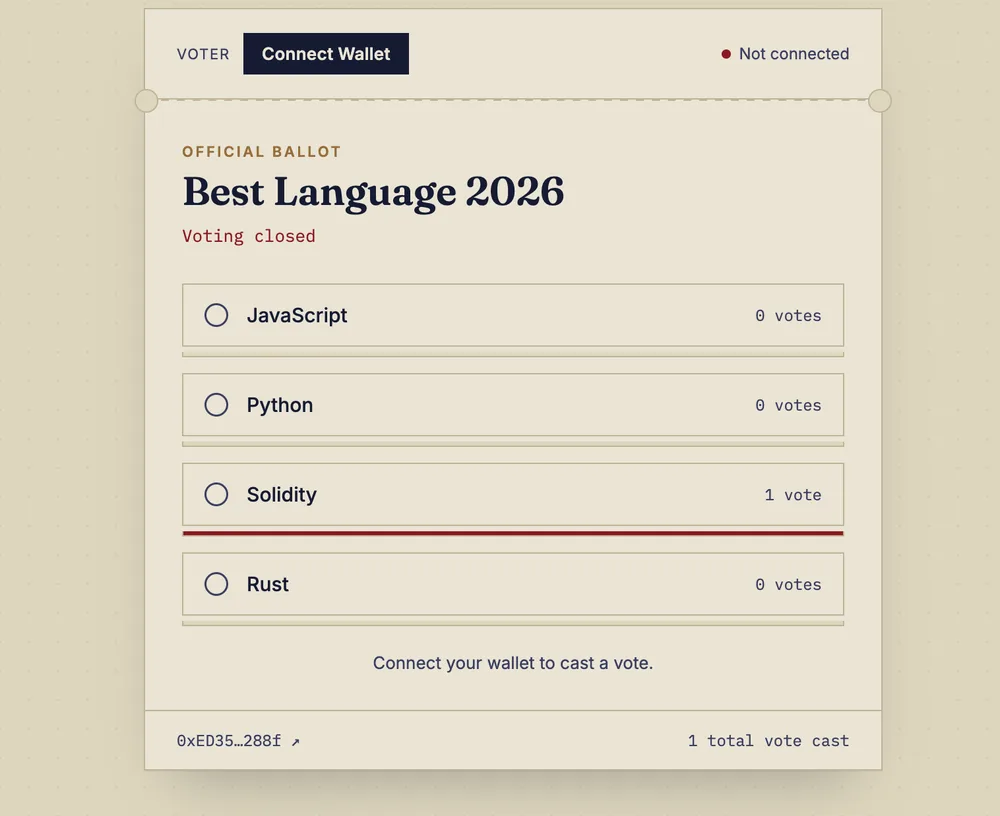
Screenshot of the On-Chain Voting dApp interface
03Live

On-Chain Voting dApp

A minimal voting contract, deliberately kept small so the interesting part could be the frontend: a ballot UI styled to look like an actual official paper ballot rather than a typical crypto dashboard. The goal was to test whether a blockchain voting interface could feel familiar to someone who's never touched a wallet before — same visual language as a polling booth, with the wallet connection and transaction confirmation handled quietly in the background.

Hardhat handled local contract testing and deployment scripting; ethers.js bridged the contract calls to the UI. It's a small project, but it's the direct descendant of my final-year university project — same core idea (votes as immutable on-chain records), much cleaner execution.

Contract
Solidity · Hardhat
Frontend
React · ethers.js
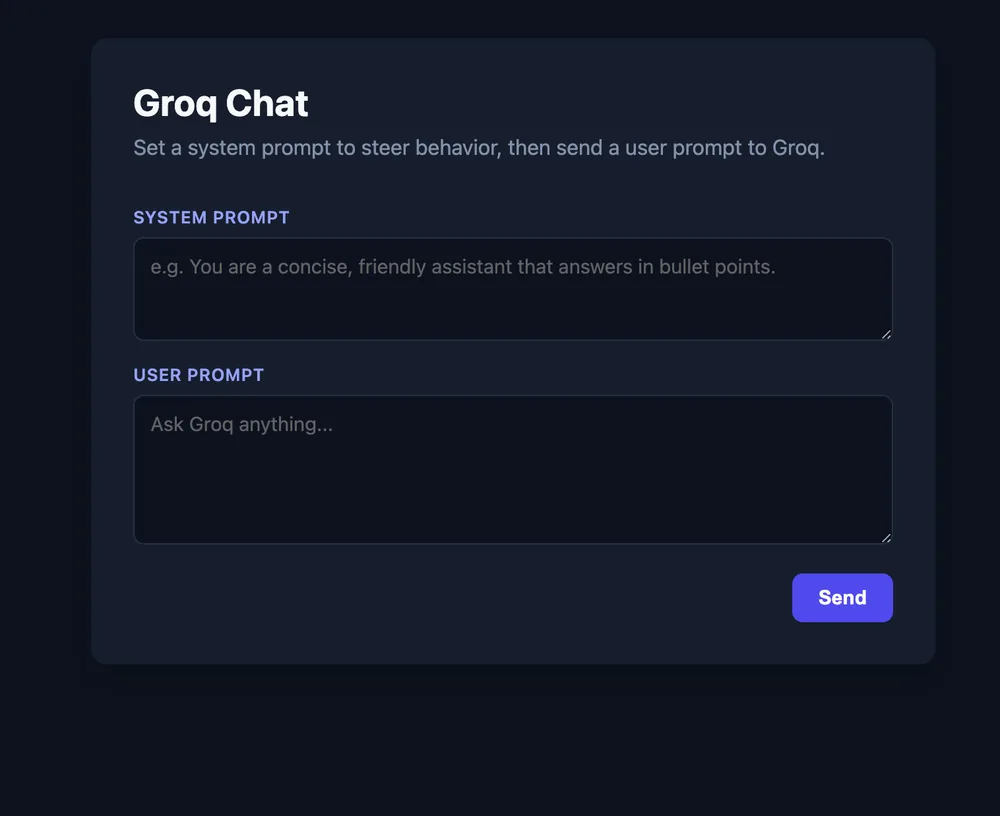
Screenshot of the Groq Chat App interface
04Live

Groq Chat App

A full-stack chat interface built to get hands-on with fast LLM inference. The Express backend handles the API calls and keeps the key server-side; the Vite/React frontend is deliberately simple so the focus stays on the model interaction rather than UI chrome. Responses are returned complete rather than streamed, with a progress bar covering the wait — including Render's cold-start window on the backend.

A deliberate scope limitation worth naming: each submission is stateless — one system prompt plus one user prompt, with no memory of prior turns. That removes any accumulating-context cost, but also means there is no multi-turn conversation capability.

Frontend
React
Backend
Node.js · Express · Groq API
05

Election System Using Blockchain (SISC)

My university final-year project, and the one that got me into blockchain in the first place. Unlike public, permissionless blockchains, this uses Hyperledger Fabric — a permissioned blockchain, meaning only known, vetted participants can validate transactions. That's a deliberate choice: for something like an election, you often want accountability and known identities behind each validating node, not full anonymity.

Built and deployed through the IBM Blockchain VS Code extension, which handles a lot of the Fabric network scaffolding that would otherwise be painful to configure by hand.

Network
Hyperledger Fabric
Tooling
IBM Blockchain VS Code extension
06

Analyzing Students' Mental Health

A data-driven look at whether studying abroad measurably affects student mental health, using PostgreSQL to structure and query the underlying survey data. Less flashy than the blockchain work, but it's the project that keeps my data-analysis and SQL skills honest.

Database
PostgreSQL
Method
Data analysis
07

Pet Recognition (CNN)

Convolutional neural network classifying cats vs. dogs at ~90% accuracy.

Model
Convolutional neural network
Field
Machine learning
08

Campus Management Solution

A Java application backed by an Oracle database for storing student, teacher, and course records — the kind of project that's less about novelty and more about getting the fundamentals of relational schema design and Java application architecture right.

App
Java
Database
Oracle SQL

Have a project in mind?
Let's build something useful.

Whether you're looking for a developer, need help with a web application, automation, AI integration, or a blockchain project — or just want to talk technology — feel free to reach out.

Download resume

Enter the access key I shared with you.

Don't have a key? Request my resume.