
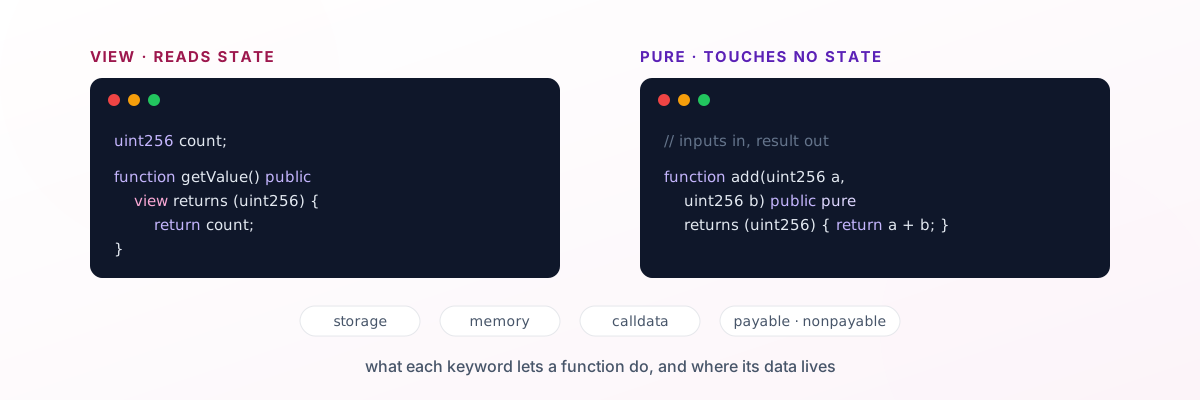
If you are learning Solidity, two keywords you will encounter very quickly are view and pure.
At first they seem simple:
function getValue() public view returns (uint256) {
    return value;
}
and:
function add(uint256 a, uint256 b)
    public
    pure
    returns (uint256)
{
    return a + b;
}
But the difference becomes much clearer when the Solidity compiler rejects your code.
I recently encountered exactly that while testing a FundMe contract with Foundry — see the Foundry debugging series for the other real errors that came out of that same project. The compiler reported:
Function declared as pure, but this expression
(potentially) reads from the environment or state
and thus requires "view".
It also reported:
Function cannot be declared as pure because this
expression (potentially) modifies the state.
Understanding why these errors happen requires understanding three related Solidity concepts:
- Function state mutability:
pure,view,payable, and the default non-payable behavior. - Solidity variable and data types.
- Data locations such as
storage,memory, andcalldata.
Let’s examine them together.
What Does Function Mutability Mean in Solidity?
Solidity functions can declare restrictions describing what they are allowed to do with blockchain state.
The four important cases are:
| Function type | Read blockchain state? | Modify blockchain state? | Receive ETH? |
|---|---|---|---|
pure |
No | No | No |
view |
Yes | No | No |
| Default / non-payable | Yes | Yes | No |
payable |
Yes | Yes | Yes |
The official Solidity documentation on contracts defines pure as disallowing access to or modification of state, while view disallows modification but permits reading state. payable allows Ether to accompany a function call.
This gives us a useful mental model:
pure
  ↓
view
  ↓
non-payable
As we move downward, the function is allowed to interact with more blockchain state.
payable is different because it specifically determines whether a function can receive Ether.
Solidity pure Functions
A pure function does not depend on contract state or blockchain state.
Its output should depend only on information such as its parameters and locally calculated values.
For example:
// SPDX-License-Identifier: MIT
pragma solidity ^0.8.36;

contract Calculator {
    function add(
        uint256 a,
        uint256 b
    ) public pure returns (uint256) {
        return a + b;
    }
}
The function receives two values:
a
b
and calculates:
a + bIt does not need to read anything stored in the contract.
That makes pure appropriate.
Another example is:
function calculateDouble(
    uint256 number
) public pure returns (uint256) {
    uint256 result = number * 2;

    return result;
}
Again, everything needed by the function comes from its argument or local variables.
What Can’t a pure Function Do?
Suppose we create a state variable:
uint256 public favoriteNumber = 42;Then try this:
function getFavoriteNumber()
    public
    pure
    returns (uint256)
{
    return favoriteNumber;
}
This will not compile.
Why?
Because:
favoriteNumberis a state variable.
The function is reading information stored by the contract.
A pure function promises that it does not access contract state, so the compiler rejects the function.
The correct declaration is:
function getFavoriteNumber()
    public
    view
    returns (uint256)
{
    return favoriteNumber;
}
The official Solidity documentation describes state variables as variables whose values are stored as part of contract state, normally in persistent contract storage.
Solidity view Functions
A view function can read blockchain or contract state but cannot modify it.
Consider:
contract Counter {
    uint256 public count = 10;

    function getCount()
        public
        view
        returns (uint256)
    {
        return count;
    }
}
The function reads:
countbut never changes it.
Therefore:
viewis appropriate.
You can think of view as saying:
“I need to look at blockchain state, but I promise not to change it.”
A view Function Cannot Modify State
This code is incorrect:
uint256 public count;

function increaseCount() public view {
    count++;
}
The problem is:
count++;changes contract storage.
The function therefore cannot be view.
The correct version is:
function increaseCount() public {
    count++;
}
Notice that there is no view, pure, or payable keyword.
That is a normal state-changing function.
The Default: Non-Payable Functions
A normal Solidity function might look like:
function setNumber(uint256 newNumber) public {
    number = newNumber;
}
This function can read and modify state.
Because it is not declared payable, however, callers cannot normally attach Ether to the function call.
At the ABI level, Solidity identifies this state mutability as nonpayable. The ABI specification distinguishes pure, view, nonpayable, and payable function state mutability.
You normally don’t write:
nonpayablein Solidity source code.
Instead:
function setNumber(uint256 newNumber) public {is non-payable by default.
Solidity payable Functions
A payable function is specifically allowed to receive Ether.
For example:
function fund() public payable {
}
Now someone can call the function while sending ETH.
Inside the function, you can inspect the amount sent using:
msg.valueFor example:
function fund() public payable {
    require(
        msg.value >= 0.01 ether,
        "Send at least 0.01 ETH"
    );
}
This pattern is common in crowdfunding contracts, payment contracts, DeFi applications, and teaching projects such as FundMe — see why I built a blockchain notary for another example of a Solidity project built around similar defensive-engineering habits.
The important distinction is:
view      → reads state
pure      → does not read state
payable   → can receive ETH
These concepts answer different questions.
A Real Foundry Error: pure vs State Modification
This distinction became particularly clear while I was testing a FundMe project with Foundry. If you’ve hit other Foundry errors, the full debugging series covers the --mt flag, forge-std/Test.sol import issues, PATH problems on macOS, and Anvil/MetaMask mismatches.
My HelperConfig.s.sol contained logic similar to:
function getOrCreateAnvilEthConfig()
    public
    pure
    returns (NetworkConfig memory)
{
    if (activeNetworkConfig.priceFeed != address(0)) {
        return activeNetworkConfig;
    }

    vm.startBroadcast();

    MockV3Aggregator mockPriceFeed =
        new MockV3Aggregator(
            DECIMALS,
            INITIAL_PRICE
        );

    vm.stopBroadcast();

    return NetworkConfig({
        priceFeed: address(mockPriceFeed)
    });
}
Running:
forge test --fork-url $SEPOLIA_RPC_URLcaused Solidity to complain that the function had been declared pure.
There are actually multiple problems.
Problem 1: Reading a State Variable
The function contains:
activeNetworkConfig.priceFeedactiveNetworkConfig is contract state.
A pure function cannot read that state.
Even this would already make pure invalid:
if (activeNetworkConfig.priceFeed != address(0)) {
    return activeNetworkConfig;
}
If reading state were the only thing the function did, changing the function to view might solve the problem.
But there is another issue.
Problem 2: Deploying a Contract Changes State
The function also contains:
new MockV3Aggregator(
    DECIMALS,
    INITIAL_PRICE
);
The new expression creates a contract.
That means the function is doing more than reading state.
It is performing a state-changing action.
Therefore, this would also be incorrect:
function getOrCreateAnvilEthConfig()
    public
    view
    returns (NetworkConfig memory)
view is still too restrictive.
The correct approach is to remove the mutability modifier:
function getOrCreateAnvilEthConfig()
    public
    returns (NetworkConfig memory)
{
Now the function is allowed to interact with state as required.
Foundry provides Forge, Anvil, Cast, Chisel, and Solidity cheatcodes for smart-contract development and testing; cheatcodes can control execution and state in testing and scripting environments.
pure vs view: The Easiest Way to Remember It
Consider these four functions:
uint256 public number = 10;

function add(
    uint256 a,
    uint256 b
) public pure returns (uint256) {
    return a + b;
}

function getNumber()
    public
    view
    returns (uint256)
{
    return number;
}

function setNumber(uint256 newNumber) public {
    number = newNumber;
}

function deposit() public payable {
}
Their responsibilities are different.
add()performs computation only.
getNumber()reads contract state.
setNumber()changes contract state.
deposit()can receive ETH.
That distinction is far more useful than simply memorizing definitions.
Function Mutability vs Function Visibility
Another common source of confusion is mixing up mutability and visibility.
These are different concepts.
Consider:
function getPrice()
    public
    view
    returns (uint256)
{
    // ...
}
Here:
publicdescribes who can call the function.
Meanwhile:
viewdescribes what the function can do to blockchain state.
Common visibility modifiers are:
public
private
internal
external
Common state-mutability categories are:
pure
view
payable
non-payable
So a function can be:
external viewor:
public pureor:
external payablebecause visibility and mutability solve separate problems.
Solidity Variable Types
Understanding pure and view also becomes easier once you understand how Solidity handles variables.
Solidity is a statically typed language, meaning the type of a variable must be known. The official documentation on types divides Solidity types into categories including value types, reference types, mappings, and user-defined types.
Let’s look at the most important ones.
Value Types in Solidity
Value types contain their values directly.
Common examples include:
bool
uint256
int256
address
bytes32
For example:
bool public isActive = true;

uint256 public balance = 100;

int256 public temperature = -5;

address public owner;
Solidity supports unsigned integers such as:
uint8
uint16
uint32
uint64
uint128
uint256
and signed integers such as:
int8
int16
int32
int64
int128
int256
uint is an alias for:
uint256and int is an alias for:
int256Value types are copied when passed or assigned rather than behaving like references to the same data.
address and address payable
Ethereum addresses can be represented using:
addressFor example:
address public owner;An address intended for operations that involve receiving Ether may need:
address payableFor example:
address payable public recipient;These two concepts should not be confused with a payable function.
address payableis an address type.
function deposit() public payabledeclares a function capable of receiving ETH.
They use the same word because both relate to Ether transfers, but they apply to different Solidity constructs.
Reference Types in Solidity
Reference types do not always behave like simple copied values.
Important reference types include:
arrays
structs
Mappings also have special reference/storage behavior.
For example:
uint256[] public numbers;A struct could look like:
struct Person {
    string name;
    uint256 age;
}
and a mapping could look like:
mapping(address => uint256) public balances;According to the Solidity documentation on reference types, reference types require careful handling because multiple variables may refer to the same underlying data. Their data location determines where that data lives.
That leads to one of Solidity’s most important concepts.
storage, memory, and calldata in Solidity
Developers coming from JavaScript, Python, Java, or C++ often find Solidity’s data-location keywords unusual.
The three locations you will see most often are:
storage
memory
calldata
They describe where reference-type data lives. Solidity’s documentation on data location defines these three primary data locations for reference types.
storage
storage represents persistent contract storage.
Consider:
string public name = "Ahmed";Because this is a state variable, its value belongs to contract storage.
Storage persists between transactions.
For example:
struct User {
    string name;
    uint256 age;
}

User public user;
The user state variable remains part of the contract state until something changes it.
Persistent storage is comparatively expensive, so developers should be deliberate about what they store on-chain. The Solidity documentation describes contract storage as persistent across function calls and transactions.
memory
memory is temporary.
For example:
function createMessage()
    public
    pure
    returns (string memory)
{
    string memory message = "Hello Solidity";

    return message;
}
The message variable only needs to exist while the function executes.
It does not become permanent contract state.
Another example:
function processNumbers(
    uint256[] memory numbers
) public pure returns (uint256) {
    return numbers.length;
}
Once the function call is finished, that memory is not persistent contract storage.
calldata
calldata is commonly used for function arguments that should not be modified.
For example:
function processNames(
    string[] calldata names
) external pure returns (uint256) {
    return names.length;
}
The Solidity documentation describes calldata as non-modifiable and non-persistent and notes that using it can avoid unnecessary copies when appropriate.
A useful rule of thumb is:
storage  → persistent blockchain state
memory   → temporary modifiable data
calldata → temporary read-only input data
storage vs memory: Why the Difference Matters
Suppose we have:
struct Person {
    string name;
    uint256 age;
}

Person public person;
Now consider:
function updateAge(uint256 newAge) public {
    Person storage currentPerson = person;

    currentPerson.age = newAge;
}
Here:
Person storage currentPersonpoints to the actual state variable.
Changing:
currentPerson.agetherefore changes:
person.ageNow compare that concept with a memory copy.
Assignments that cross data locations can result in copies, while storage references can refer to the existing storage object. The exact assignment behavior is documented in the data location and assignment behaviour section of the docs, because it affects both correctness and gas usage.
State Variables, Local Variables, and Function Parameters
Where a variable is declared also matters.
A state variable exists at contract level:
contract Example {
    uint256 public number;
}
A local variable exists inside a function:
function calculate()
    public
    pure
    returns (uint256)
{
    uint256 result = 5 + 10;

    return result;
}
A function parameter receives information from the caller:
function multiply(
    uint256 a,
    uint256 b
) public pure returns (uint256) {
    return a * b;
}
Here:
numberis state.
resultis local.
a
b
are parameters.
This distinction directly affects whether pure or view is appropriate.
constant Variables in Solidity
Sometimes a value will never change.
Solidity lets us declare such a state variable using:
constantFor example:
uint256 public constant MINIMUM_USD = 5e18;The value must be known at compile time.
Another example:
uint256 public constant MAX_USERS = 1000;constant is useful for values that are permanently fixed.
The official Solidity documentation on constant and immutable state variables states that constant state variables must have values fixed at compile time.
immutable Variables in Solidity
immutable is similar to constant, but its value can be assigned during contract construction.
For example:
address public immutable OWNER;

constructor() {
    OWNER = msg.sender;
}
Different deployments may therefore have different owners.
But once the contract has been deployed, that immutable value cannot be changed.
This distinction makes:
constantappropriate when the value is known during compilation, while:
immutableis useful when the value becomes known during deployment.
The same section of the Solidity documentation linked above specifically distinguishes compile-time constant values from immutable values that may be assigned during construction.
Putting Everything Together
Here is a small contract demonstrating several of these concepts:
// SPDX-License-Identifier: MIT
pragma solidity ^0.8.36;

contract SolidityTypesExample {
    uint256 public number = 10;

    uint256 public constant MAX_VALUE = 1000;

    address public immutable owner;

    mapping(address => uint256) public balances;

    constructor() {
        owner = msg.sender;
    }

    // PURE:
    // Uses only parameters and calculation.
    function add(
        uint256 a,
        uint256 b
    ) public pure returns (uint256) {
        return a + b;
    }

    // VIEW:
    // Reads contract state.
    function getNumber()
        public
        view
        returns (uint256)
    {
        return number;
    }

    // STATE-CHANGING:
    // Modifies storage.
    function setNumber(
        uint256 newNumber
    ) public {
        require(newNumber <= MAX_VALUE);

        number = newNumber;
    }

    // PAYABLE:
    // Can receive ETH.
    function deposit() public payable {
        balances[msg.sender] += msg.value;
    }

    // VIEW:
    // Reads the contract's ETH balance.
    function getContractBalance()
        public
        view
        returns (uint256)
    {
        return address(this).balance;
    }

    // PURE + CALLDATA:
    // Reads external input but not contract state.
    function getArrayLength(
        uint256[] calldata values
    ) external pure returns (uint256) {
        return values.length;
    }
}
This example demonstrates that the keywords work together rather than independently.
The question is not simply:
“Should this function be
vieworpure?”
A better debugging process is:
Does the function modify blockchain state?
        │
        ├── Yes → normal state-changing function
        │
        └── No
             │
             ├── Does it read blockchain/contract state?
             │       │
             │       ├── Yes → view
             │       │
             │       └── No → pure
             │
             └── Does it need to receive ETH?
                     └── If yes, payable is required
That mental model makes compiler errors much easier to understand.
Common Solidity Mutability Mistakes
One common mistake is declaring every getter pure.
If it reads a state variable:
return price;it normally needs to be view, not pure.
Another mistake is assuming view means “this function returns something.”
It doesn’t.
A function can return a value without being view:
function increment()
    public
    returns (uint256)
{
    number++;

    return number;
}
The function returns a number but also modifies state.
Therefore it cannot be view.
Similarly, pure does not mean “simple function.”
It specifically means the function does not access or modify blockchain state.
Finally, remember that public, private, internal, and external describe visibility, while pure, view, and payable describe state mutability.
Frequently Asked Questions
What is the difference between view and pure in Solidity?
A view function can read contract or blockchain state but cannot modify it. A pure function cannot read or modify blockchain state.
For example:
uint256 public number = 10;

function getNumber()
    public
    view
    returns (uint256)
{
    return number;
}
uses view because it reads number.
Meanwhile:
function double(
    uint256 x
) public pure returns (uint256) {
    return x * 2;
}
can be pure because the calculation depends only on its input.
Can a view function change a state variable?
No.
This is invalid:
function update() public view {
    number = 10;
}
Changing a state variable modifies contract state, which violates the view restriction.
Can a pure function read a state variable?
No.
For example:
function getNumber()
    public
    pure
    returns (uint256)
{
    return number;
}
will fail because number is contract state.
Use:
viewinstead.
Can a pure function use function arguments?
Yes.
This is perfectly valid:
function subtract(
    uint256 a,
    uint256 b
) public pure returns (uint256) {
    return a - b;
}
The values are provided directly to the function rather than being read from contract state.
What happens if I don’t specify view, pure, or payable?
The function is non-payable by default.
It can read and modify contract state, but Ether cannot normally be attached to the call. Solidity’s ABI represents this category as nonpayable.
What is the difference between memory and calldata?
Both are temporary rather than permanent contract storage.
memory data can be modified during execution, while calldata is non-modifiable input data.
When function arguments do not need to be modified, calldata can also avoid unnecessary copying.
Is storage permanent?
Contract storage persists across function calls and transactions until contract logic changes the stored values. This is fundamentally different from memory, which is created for a call and does not become permanent state.
Why does Foundry say “Function declared as pure”?
This is a Solidity compiler error rather than a problem with the forge test command itself.
It generally means the function was marked:
purebut its implementation reads blockchain state or performs an operation incompatible with a pure function.
Inspect the compiler’s referenced line.
If the function only reads state, it may need:
viewIf it changes state, deploys a contract, or performs other state-changing operations, remove pure rather than blindly replacing it with view.
Final Thoughts
pure, view, and payable are not simply decorations added to Solidity functions.
They describe important constraints on how a function interacts with the Ethereum execution environment.
The core distinction is straightforward:
pure
→ computation without reading or modifying blockchain state

view
→ read blockchain state but don't modify it

normal/non-payable
→ read and modify state

payable
→ can receive Ether
At the same time:
storage
→ persistent contract data

memory
→ temporary function data

calldata
→ temporary read-only input data
And for state variables:
constant
→ fixed at compile time

immutable
→ assigned during construction and fixed afterward
Once these concepts are understood together, compiler errors such as:
Function declared as pure, but this expression
potentially reads from the environment or state
stop looking mysterious.
Instead, the compiler is telling you something useful about what your function is actually doing.
In my FundMe example, the function wasn’t really pure at all. It read the active network configuration, used Foundry scripting functionality, and deployed a mock price-feed contract.
Removing pure wasn’t simply a way to silence the compiler.
It made the function declaration accurately describe the behavior of the code.
And that is exactly what Solidity’s mutability system is designed to enforce.
If you’re working through similar Foundry issues, the debugging series covers five more real errors, or get in touch if you need help with a Solidity or Foundry project directly.
References
This article was checked against the official Solidity documentation covering contracts and state mutability, types, value/reference types, and data locations, and the contract ABI specification, as well as the official Foundry documentation for the development framework.