
In 2016, Michael Dansinger of Tufts Medical Center found his own rejected manuscript published in another journal. He had submitted it to Annals of Internal Medicine, which turned it down. Later, almost the same text, tables and figures appeared in EXCLI Journal under a different author list. Annals checked its records and found that one of the paper’s reviewers was among the new paper’s co-authors. The copied paper was retracted, and Annals published Dansinger’s open letter to the reviewer (Retraction Watch).
The case ended well for the author partly because a journal kept good records. Annals knew who had reviewed the paper and when it had arrived. But that evidence sat inside one journal’s system. Most priority disputes are messier: two groups, two journals, and no record that both sides accept.
This post explains what manuscript timestamping is, what it can and can’t prove, and how a journal running Open Journal Systems (OJS) can add it without changing how editors work.
Journals were invented partly to settle priority
Recording who submitted what, and when, is one of the oldest jobs a journal has. When Henry Oldenburg started Philosophical Transactions in 1665, scientists hesitated to share results without credit for being first. The journal recorded each author’s name and the date their manuscript arrived, so authors could publish knowing their priority was on record (Mabe, UKSG).
That job never went away. It’s why many articles still print “Received” and “Accepted” dates. The JATS publishing standard has a dedicated <history> element for them, kept separate from the publication date (NLM JATS tag library).
What has changed is the scale of the risk. Manuscripts now pass through email, submission systems, reviewers in several countries, and sometimes AI tools. A “received” date printed by the journal is only as trustworthy as the journal, and only visible after publication. A rejected paper never gets one at all.
What OJS already records, and the gap
OJS keeps a detailed internal record. Every submission has a date submitted, and its History shows a log of events, visible only to editorial and administrative staff (OJS editorial workflow manual). For day-to-day work that is exactly right.
As evidence in a dispute, it has three limits:
- It’s held by one party. The log lives in the journal’s own database. Anyone outside, such as an author, a second journal or a university panel, has to take the journal’s word for it.
- It can be changed. Administrators with database access can edit rows. Most never would, but “they could” is enough to weaken it as proof.
- It disappears with the server. If the journal migrates badly, loses a backup or closes, the history goes with it.
None of this is a flaw in OJS. A database is meant to be editable. Proof of existence needs something nobody can quietly edit, including the journal itself.
What a timestamp actually proves
A manuscript timestamp has two parts.
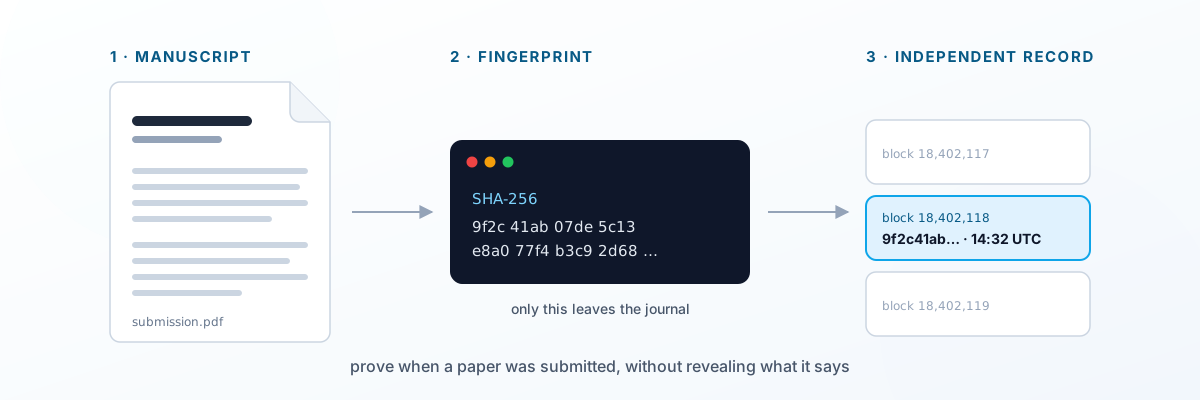
- A fingerprint of the file. A cryptographic hash such as SHA-256 turns the file into a short string of characters. The same file always gives the same fingerprint. Changing a single comma gives a completely different one, and you can’t work backwards from the fingerprint to the text.
- A record that the fingerprint existed at a certain time, kept somewhere independent of the journal and the author.
Together they let anyone check, later, that this exact file existed no later than this date. Hash the file again, compare the fingerprints, and look up the independent record. (If you want to try that yourself, here is how to check if a file has been changed on Windows, Mac or a phone.)
Be precise about the limits, because overselling them backfires in a dispute:
- It proves existence by a time, not that nobody had the idea earlier.
- It proves integrity: the file is byte-for-byte what was stamped. A revised version needs its own stamp.
- It does not prove authorship. Whoever holds a file can stamp it. Authorship evidence still comes from the journal’s records, emails and drafts. The timestamp makes those harder to dispute.
- It’s not a legal notarization. No identity check or legal witness is involved.
The privacy advantage is what makes this useful to journals. Only the fingerprint leaves the building. The manuscript stays confidential, which matters under double-blind review, for unpublished data, or for work heading towards a patent.
Three ways to timestamp a manuscript
1. Post a preprint
For many fields, a preprint is the simplest priority record. A bioRxiv preprint, for example, gets a public timestamp and a DOI once it passes screening, usually within 72 hours (bioRxiv FAQ).
The catch is that a preprint is public. That suits open science, but not a confidential submission, a journal that doesn’t accept preprinted work, or research that isn’t ready to be seen. It’s also the author’s choice, not something a journal can do on an author’s behalf.
2. A trusted timestamping authority (RFC 3161)
The internet standard RFC 3161, published in 2001, defines a Time Stamping Authority: a trusted third party that receives a file’s hash, not the file, and returns a signed token proving the data existed at that moment (RFC 3161). It’s the same mechanism used to timestamp code signatures and signed PDFs.
The trust sits with the authority. If its signing key is respected, so is the token. Commercial authorities charge per stamp or per year, and some free services exist for low volumes.
3. A public blockchain
A blockchain removes the single trusted party. The file’s fingerprint is written into a public ledger that thousands of computers keep copies of, so the record can’t be edited or deleted by any one of them.
OpenTimestamps does this on Bitcoin for free. It groups many fingerprints into one Bitcoin transaction through public calendar servers, with no account or API key. On other blockchains, such as Ethereum and its cheaper layer-2 networks, a small contract can store each fingerprint with the block’s time. I built that kind of system as the Document Notary and wrote about why a blockchain fits this job. It currently runs on a test network for demonstration. So for proofs that must last, use OpenTimestamps or an RFC 3161 service today.
| Preprint | RFC 3161 authority | Public blockchain | |
|---|---|---|---|
| Manuscript stays private | No | Yes | Yes |
| Who you trust | The preprint server | The authority’s signing key | The network itself |
| Typical cost | Free | Free to paid, per stamp | Free (OpenTimestamps) to a few cents |
| Who can do it | Authors | Authors or the journal | Authors or the journal |
A practical workflow for OJS journals
The simplest version needs no plugin and no change for authors. It suits a small journal and takes a few minutes per submission.
- Stamp on arrival. When a new submission comes in, the managing editor downloads the submitted file and creates a timestamp with whichever tool the journal chose.
- Store the proof with the submission. Upload the proof file to the submission or record its reference in the History notes, so it stays with the editorial record.
- Stamp each revision. Every new version gets its own stamp, so the whole submission history can be checked.
- Tell authors in the submission guidelines. One sentence is enough: “We record a cryptographic timestamp of every submitted file. Only the file’s fingerprint is shared, never its contents.”
- Use it when a question comes up. The Committee on Publication Ethics’ flowchart for a reviewer suspected of taking an author’s ideas asks editors to gather as much documentary evidence as possible (COPE flowchart). A timestamp is exactly that kind of evidence, and it doesn’t depend on anyone trusting the journal.
The next step is to automate it. OJS can run custom code when a submission or revision arrives, so a plugin can create and store the stamp without anyone remembering to do it. If your journal would like that set up, it’s part of my OJS support work. The OJS hub has more on running OJS well, including how to upgrade safely.
What to tell authors who ask “can my idea be stolen?”
Be honest: no tool prevents a dishonest reviewer from copying ideas. What a timestamp changes is the aftermath. An author who can show that their exact manuscript existed on a given date, with a record that nobody controls, is in a much stronger position than one relying on email headers and memory.
Authors can also protect themselves without waiting for their journal. Stamping a manuscript with OpenTimestamps before submitting takes a minute and costs nothing. Keeping the proof file with the manuscript is all it asks.
The bottom line
Journals have recorded submission dates since 1665 because priority matters to researchers. What’s new is that the record no longer has to live only in the journal’s own files. A timestamped fingerprint is private, cheap, quick to make, and checkable by anyone, including the journal’s critics.
For an OJS journal, the minimum is a short routine: stamp each file on arrival, keep the proof with the submission, and say so in the author guidelines. It costs a few minutes per paper and could settle a dispute that would otherwise come down to one side’s word against the other’s.